Wondering how much it really costs to run your air conditioner? You’re not alone.
When the temperature rises, your AC becomes a lifeline—but those energy bills can quickly catch you off guard. What if you could understand exactly where your money goes and find simple ways to save? You’ll discover clear answers and practical tips that put you in control of your cooling costs.
Keep reading to make your air conditioner work smarter, not harder, while keeping your wallet happy.

Credit: northnjhvac.com
Factors Affecting Ac Costs
Energy consumptionplays a big role in AC costs. Larger units use more power, raising bills.
The size of the AC unitaffects how much electricity it uses. Bigger rooms need bigger units.
Usage patternsmatter. Running the AC for many hours daily increases costs.
Local electricity ratesdiffer. Some areas charge more per kilowatt-hour than others.
Maintenance and repairshelp keep the AC working well. Regular checks avoid costly fixes later.
| Factor | Impact on Cost |
|---|---|
| Energy Consumption | More power use means higher bills |
| AC Unit Size | Bigger units consume more electricity |
| Usage Patterns | Longer use raises electricity costs |
| Local Electricity Rates | Higher rates increase monthly charges |
| Maintenance and Repairs | Regular care saves money on repairs |
Calculating Daily Running Costs
Air conditioners use different wattagebased on their size and model. Smaller units use about 500 to 1,500 watts. Larger ones may use 2,000 watts or more. Knowing the wattage helps find how much power the AC uses per hour.
The hours of operationaffect total energy use. Running an AC for 8 hours uses twice the energy of running it for 4 hours. Tracking daily use helps estimate costs.
| Factor | Example | Explanation |
|---|---|---|
| Wattage | 1,200 W | Power used per hour by the AC |
| Hours | 6 hours | Daily usage time |
| Electricity Rate | $0.12/kWh | Cost per kilowatt-hour from utility |
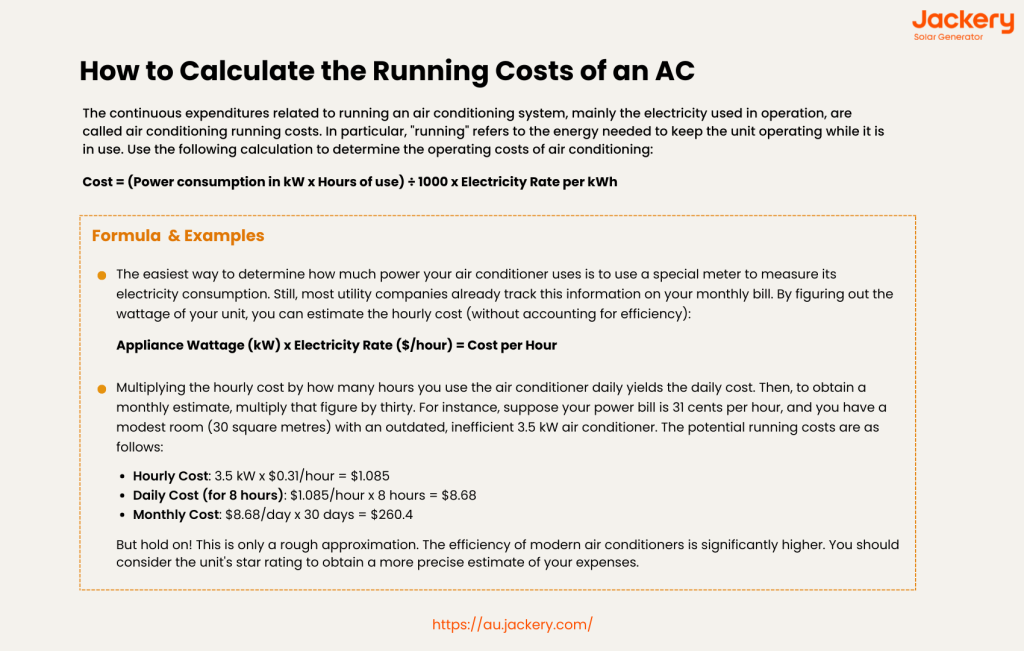
To calculate daily cost, multiply the wattage by hours used. Then divide by 1,000 to get kilowatt-hours (kWh). Multiply kWh by your electricity rate. This gives the daily running cost in dollars.
Cost Differences By Ac Type
Different types of air conditioners use energy at different rates, affecting your electricity bill. Central ACs often cost more to run than window units or portable models. Choosing the right type can help manage cooling expenses effectively.
Window Units
Window AC unitsare usually the cheapest option. They cost less to buy and install. These units cool small rooms well. But, they use more electricity than some other types. Their energy efficiency can vary a lot.
Split Systems
Split AC systems have two parts: an indoor and outdoor unit. They cost more upfront than window units. But they use less electricity. They work well for cooling larger spaces. Installation is more complex and costly.
Central Air Conditioning
Central AC systems cool entire homes. They have the highest installation costs. Energy use depends on home size and insulation. These systems are best for big houses. Maintenance costs can be higher than other AC types.
Portable Acs
Portable ACs are easy to move around. Their purchase price is moderate. They use more electricity than split systems. Portable units cool small areas. Installation is simple and needs no extra work.
Ways To Reduce Ac Expenses
Energy-efficient models use less power and save money. Look for units with a good Energy Star rating.
Smart thermostats help control temperature easily. They learn your schedule and adjust cooling automatically.
Regular maintenance keeps your AC running smoothly. Clean filters and check for leaks to improve efficiency.
Improved insulation stops cool air from escaping. Seal windows and doors to keep your home cooler.
Using fans and ventilation reduces the need for AC. They help move air and cool rooms naturally.
Seasonal And Regional Cost Variations
Summer monthsusually cost more to run an air conditioner due to higher temperatures. The unit runs longer to cool your home. Shoulder seasonslike spring and fall have milder weather, so AC use is less frequent and cheaper.
Places with hot climates see higher cooling costsbecause air conditioners work harder. Cooler areas spend less on cooling since the AC runs less.
| Region | Average Electricity Price (per kWh) | Impact on AC Cost |
|---|---|---|
| South | $0.13 | Higher cost due to hot weather and higher prices |
| Midwest | $0.11 | Moderate cost with seasonal variations |
| West Coast | $0.20 | Higher cost mainly due to higher electricity prices |
| Northeast | $0.18 | Moderate to high costs depending on the season |

Credit: www.hhaircon.com.au
Estimating Annual Air Conditioning Costs
On average, air conditioners run about 8 hours dailyduring summer months. Usage varies by location and weather. The monthly costdepends on the unit’s power and local electricity rates.
Peak months often cause bills to double or triplecompared to cooler months. Planning for these spikes helps avoid surprises. Using a programmable thermostatcan reduce costs.
| Month | Average Usage (hours/day) | Estimated Monthly Cost ($) |
|---|---|---|
| June | 6 | 30 |
| July | 10 | 50 |
| August | 10 | 50 |
| September | 5 | 25 |
Credit: www.furnaceprices.ca
Frequently Asked Questions
What Factors Affect Air Conditioner Running Costs?
The cost to run an air conditioner depends on several factors. These include the unit’s efficiency, the size of your space, local electricity rates, and how often you use it. Weather conditions and insulation quality also play significant roles. Understanding these factors can help you estimate your AC operating expenses more accurately.
How Does Ac Size Impact Electricity Bills?
A properly sized air conditioner is crucial for efficiency. An undersized unit works harder, increasing energy use. Conversely, an oversized unit frequently cycles on and off, wasting energy. Both scenarios lead to higher electricity bills. It’s essential to choose the right size for your space to optimize energy consumption.
Does Regular Maintenance Reduce Ac Operating Costs?
Yes, regular maintenance can significantly lower operating costs. Well-maintained air conditioners run more efficiently and use less energy. Tasks like cleaning filters, checking refrigerant levels, and inspecting parts ensure optimal performance. This not only reduces energy bills but also extends the unit’s lifespan, saving money in the long run.
How Can I Calculate My Ac’s Energy Usage?
To calculate energy usage, you need the unit’s wattage and your electricity rate. Multiply the wattage by the hours used daily, then divide by 1,000 to get kilowatt-hours (kWh). Multiply this by your electricity rate to estimate daily costs. This method helps you understand and manage your AC expenses.
Conclusion
Running an air conditioner costs depend on many factors. Energy use, unit size, and local electricity rates matter most. Small changes, like setting a higher temperature, can save money. Regular maintenance helps the AC run efficiently and lowers bills. Understanding these costs helps you plan your budget better.
Stay cool without surprises on your energy bill. Simple steps make a big difference in cost. Keep your home comfortable and your expenses in check.