Are you wondering if air conditioner capacitors are universal? If you’ve ever needed to replace one, you know how confusing it can be.
Choosing the wrong capacitor might cause your AC to stop working or even damage it further. But what if there was a simple answer? Keep reading, and you’ll learn exactly what you need to know to make the right choice for your air conditioner.
This knowledge could save you time, money, and a lot of frustration. Don’t miss out!

Credit: www.amazon.com
Types Of Air Conditioner Capacitors
Air conditioners use capacitors to help start and run their motors. Different types of capacitors serve specific roles in the system.
Understanding these types helps in maintenance and replacement tasks.
Start Capacitors
Start capacitors provide a high boost of energy to start the compressor motor. They work only during the startup phase and disconnect once the motor runs.
Run Capacitors
Run capacitors keep the motor running smoothly after it starts. They improve the motor’s efficiency and reduce energy consumption.
- Stay in the circuit while the motor runs
- Help maintain a constant voltage supply
- Increase motor lifespan by reducing heat
Dual Capacitors
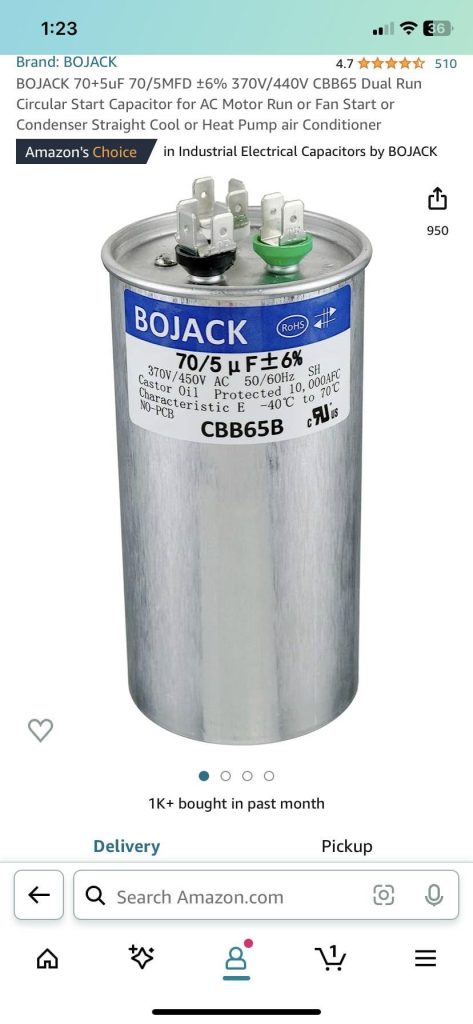
Dual capacitors combine the functions of start and run capacitors into one unit. They save space and simplify wiring in air conditioners.
| Capacitor Type | Main Function | Usage |
|---|---|---|
| Start Capacitor | Provides extra energy to start motor | Used only during motor startup |
| Run Capacitor | Keeps motor running efficiently | Active during motor operation |
| Dual Capacitor | Combines start and run functions | Used for both starting and running |
Capacitor Specifications To Consider
Air conditioner capacitors are important for starting and running the motor. Not all capacitors are the same. You need to check certain specs before choosing one.
Knowing these specifications helps you find the right capacitor for your AC unit. It keeps the system working safely and well.
Microfarad Ratings
The microfarad (µF) rating shows the capacitor’s electrical charge storage. It must match the AC motor’s needs. A wrong microfarad rating can cause poor performance or damage.
Check the old capacitor or the AC manual for the correct µF rating. Capacitors usually have a small range, but stay as close as possible to the original value.
Voltage Ratings
The voltage rating tells how much voltage the capacitor can handle. It must be equal or higher than the AC system’s voltage. Using a lower voltage capacitor is unsafe and can cause failure.
Look for capacitors with voltage ratings like 370V, 440V, or 460V. Match or exceed the system voltage for safe operation.
Physical Size And Shape
Capacitors come in different sizes and shapes. The new capacitor must fit in the AC unit’s capacitor bracket or space. Check the height, diameter, and terminal layout.
A wrong size or shape can cause installation problems. Keep the same terminal type for easy wiring and secure connections.
Compatibility Issues With Capacitors
Air conditioner capacitors are vital for starting and running the compressor and fan motors. Not all capacitors fit every air conditioner unit. Using the wrong capacitor may cause damage or poor performance.
This article explains common compatibility issues with capacitors in air conditioners. Understanding these issues helps you choose the right part for your system.
Manufacturer Variations
Different manufacturers produce capacitors with unique designs and specifications. These variations affect how capacitors fit and work with air conditioner models.
- Capacitor voltage ratings may differ by brand.
- Physical size and terminal types can vary.
- Quality and lifespan depend on manufacturer standards.
- Some brands design capacitors for specific motor types.
Model-specific Requirements
Each air conditioner model may need a capacitor with exact specs. Using a capacitor that does not match these requirements can cause failure.
| Model | Capacitance (µF) | Voltage (V) | Terminal Type |
| Model A | 35 + 5 | 440 | Spade |
| Model B | 45 + 5 | 370 | Round |
| Model C | 40 + 7 | 440 | Spade |
Impact On Performance And Safety
Using the wrong capacitor can reduce air conditioner efficiency and increase energy use. It may also cause motor overheating or failure.
- Incorrect capacitance can prevent the motor from starting.
- Wrong voltage rating risks capacitor explosion.
- Improper fit may cause loose connections and shorts.
- Unsafe capacitors increase fire hazard.
How To Identify The Right Capacitor
Air conditioner capacitors come in different sizes and ratings. Using the wrong capacitor can cause damage to your AC unit.
It is important to identify the right capacitor before replacement. This guide helps you find the correct capacitor safely.
Reading Capacitor Labels
Capacitors have labels that show their specifications. These labels include voltage, capacitance, and type.
Look for the microfarad (µF) rating and voltage rating on the label. These numbers must match your AC unit’s requirements.
- Microfarad (µF) rating shows the storage capacity
- Voltage rating indicates the maximum voltage it can handle
- Check for the capacitor type, like start or run capacitor
Consulting Manufacturer Manuals
Manufacturer manuals give exact details for replacement parts. They list the correct capacitor for each AC model.
Find the capacitor specs in the electrical section of the manual. Use these specs to buy the right part.
- Look for model number and serial number
- Check electrical specifications for capacitor values
- Follow manufacturer recommendations strictly
Using Multimeters For Testing
A multimeter helps check if a capacitor works properly. It measures capacitance and resistance.
Set the multimeter to capacitance mode, then connect the probes to capacitor terminals. Compare the reading to the label value.
- Discharge the capacitor before testing
- Use capacitance mode on the multimeter
- Read the value and compare it to the label
- Replace if the reading is far from the rated value
Risks Of Using Non-universal Capacitors
Air conditioner capacitors are important parts that help the system run smoothly. Not all capacitors fit every model. Using the wrong capacitor can cause problems.
This article explains the risks of using non-universal capacitors in air conditioners. It covers equipment damage, warranty issues, and safety hazards.
Potential Equipment Damage
Using a capacitor that does not match your air conditioner’s specifications can harm the equipment. The wrong size or rating can cause the motor to work too hard.
This extra stress can lead to overheating, reduced efficiency, and early failure of parts. Replacing the wrong capacitor may cost more than buying the correct one initially.
Warranty Concerns
Most air conditioner warranties require using parts that meet the manufacturer’s standards. Using non-universal capacitors may void the warranty.
If damage occurs after installing an incorrect capacitor, the manufacturer might refuse repairs. This can lead to out-of-pocket expenses for fixing the unit.
Electrical Hazards
Non-universal capacitors might not handle the electrical load properly. This mismatch can cause shorts, sparks, or even fires in extreme cases.
Incorrect capacitors may also fail suddenly, posing shock risks to anyone near the air conditioner during maintenance or use.

Credit: www.reddit.com
Tips For Purchasing Capacitors
Air conditioner capacitors are important parts that help your system run smoothly. Choosing the right capacitor can save you time and money.
Not all capacitors are the same. Knowing what to look for helps you buy the best one for your AC unit.
Buying From Trusted Sources
Buy capacitors from stores or websites you trust. This lowers the chance of getting fake or poor-quality parts.
Trusted sellers often provide clear information about the capacitor’s specs and warranty.
Checking For Quality Certifications
Look for capacitors that have quality certifications. These prove the product meets safety and performance standards.
- UL certification ensures safety standards
- ISO certification shows consistent manufacturing quality
- CSA certification means it meets Canadian safety rules
Certifications help you pick a reliable capacitor that lasts longer.
Considering Replacement Vs. Upgrade
Decide if you need to replace your capacitor or upgrade to a better one. Replacement means getting the same type as before.
Upgrading can improve your AC’s performance but may cost more and need professional help.
- Replacement keeps your system running without changes
- Upgrade can improve energy efficiency
- Check compatibility before upgrading
- Consult a technician if unsure

Credit: www.amazon.com
Frequently Asked Questions
What Is An Air Conditioner Capacitor?
An air conditioner capacitor is a small cylindrical device. It stores and supplies electrical energy to the AC unit’s motor. It helps start the motor and keep it running efficiently. Without a functioning capacitor, an air conditioner may not start or perform optimally.
Are All Ac Capacitors The Same?
No, AC capacitors are not universal. Capacitors come in different sizes and voltage ratings. They are designed for specific air conditioner models. Using the wrong capacitor can damage your AC unit. Always check your AC’s specifications or consult a professional for the correct capacitor.
How Do I Identify A Faulty Capacitor?
A faulty capacitor might cause your AC to not start or cool properly. You might hear a humming sound or experience frequent shutdowns. Physical signs include swelling or leaks. If you suspect a faulty capacitor, it’s best to contact a professional technician for diagnosis and replacement.
Can I Replace An Ac Capacitor Myself?
Replacing an AC capacitor is possible, but it requires caution. Capacitors store electrical energy even when the AC is off. This can be dangerous. If you’re not experienced with electrical work, it’s safer to hire a professional. They can ensure safe and proper installation.
Conclusion
Air conditioner capacitors are not always universal. Different models need specific types and sizes. Using the wrong capacitor can harm your AC unit. Always check the specifications before buying a replacement. A proper fit helps your system run smoothly. Keep your air conditioner in good shape by choosing right parts.
Knowing this saves time and money in repairs. Don’t guess—double-check to keep your AC working well.