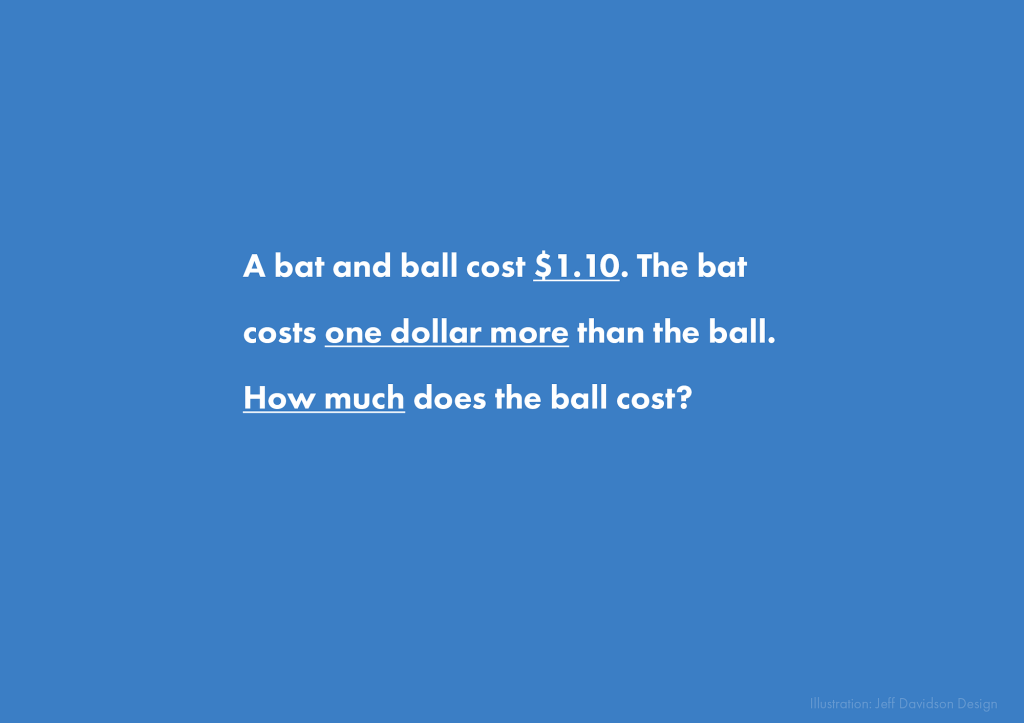
Imagine you walk into a store and see a baseball bat and a baseball priced together at $1.10. You might think, “That’s simple enough.” But here’s the twist: the bat costs exactly $1.00 more than the ball.
How much does the ball cost? It’s a question that tricks your brain and makes you pause. If you love a good puzzle and want to challenge how you think about everyday problems, this one will surprise you. Stick around, and let’s unravel this mystery together—you might just see numbers in a whole new way.
The Puzzle Setup
This puzzle asks about the cost of a baseball bat and a baseball together. The total cost is $1.10.
The puzzle also says the bat costs $1.00 more than the baseball. We need to find the cost of each item.
Cost Details
The total cost is $1.10 for both the bat and the baseball combined.
The bat costs exactly $1.00 more than the baseball does.
- Let the cost of the baseball be x dollars.
- The bat then costs x + 1.00 dollars.
- The sum of the bat and baseball costs is 1.10 dollars.
Common Assumptions
Many people think the baseball costs 10 cents. They guess the bat costs $1.00.
This is wrong because the bat costs $1.00 more than the baseball, not just $1.00 total.
- Assuming the baseball is $0.10 makes the bat $1.00.
- Adding these gives $1.10, but the bat is not $1.00 more.
- The bat must cost $1.00 more than the baseball’s price.
Why The Initial Answer Is Wrong
Many people hear the problem: A baseball bat and a baseball cost $1.10 together. The bat costs $1.00 more than the ball. They quickly say the ball costs 10 cents.
This answer seems right but is actually wrong. The math does not add up correctly. Let’s see why.
The $1.00 Misconception
The mistake is in thinking the ball costs 10 cents. If the ball costs 10 cents, the bat should cost $1.10.
Adding these gives $1.20, not $1.10. The bat cannot be $1.00 more if the ball costs 10 cents.
- Ball = $0.10
- Bat = Ball + $1.00 = $1.10
- Total = $0.10 + $1.10 = $1.20 (wrong)
Identifying The Error
To find the right answer, we must set up an equation with correct values. Let the ball cost x dollars.
The bat costs $1.00 more, so it costs x + 1.00 dollars. Together, they cost 1.10 dollars.
Equation: x + (x + 1.00) = 1.10
The ball costs 5 cents, and the bat costs $1.05. This fits the problem’s conditions perfectly.
Solving The Puzzle Step-by-step
This puzzle asks about the price of a baseball bat and a baseball together. They cost $1.10 in total. The bat costs $1.00 more than the ball.
We will solve this by setting up simple equations. Then, we calculate the cost of each item carefully.
Setting Up The Equations
First, we assign variables to the unknown costs. Let xbe the cost of the baseball.
- The bat costs $1.00 more than the baseball. So, bat cost = x + 1.00.
- The total cost of bat and ball is $1.10.
- We can write the equation: x + (x + 1.00) = 1.10.
Calculating The Costs
Now, solve the equation to find the value of x.
| Step | Calculation | Result |
|---|---|---|
| 1 | x + x + 1.00 = 1.10 | 2x + 1.00 = 1.10 |
| 2 | 2x = 1.10 – 1.00 | 2x = 0.10 |
| 3 | x = 0.10 ÷ 2 | x = 0.05 |
| 4 | Bat cost = x + 1.00 | Bat cost = 0.05 + 1.00 = 1.05 |
The baseball costs $0.05 and the bat costs $1.05. Together, they add up to $1.10 as given.
Credit: www.dailymotion.com
Mathematical Reasoning Behind The Solution
A baseball bat and a baseball cost a total of $1.10. Many wonder how much each item costs. Understanding the math helps solve this puzzle.
It seems simple, but careful thought is needed. Let’s explore how to find the correct answer.
Algebraic Approach
Start by assigning variables to the items. Let the baseball cost x dollars. The bat costs $1 more than the baseball.
This means the bat costs x + 1 dollars. Together, they add up to $1.10. Write the equation:
Solve the equation to find x. Combine like terms to get 2x + 1 = 1.10. Subtract 1 from both sides, giving 2x = 0.10. Divide both sides by 2 to find x = 0.05.
The baseball costs $0.05 and the bat costs $1.05.
Logical Thinking
Think about the problem logically. If the bat costs $1 more than the baseball, the baseball must cost less than $1.
Consider if the baseball costs $0.10. Then the bat would cost $1.10. Together, they would cost $1.20, which is too much.
- If the baseball costs $0.05, the bat costs $1.05.
- Add them together: $0.05 + $1.05 = $1.10.
- This matches the total given.
Thinking logically shows why the baseball costs $0.05 and the bat costs $1.05.
Common Variations Of The Puzzle
The puzzle about a baseball bat and a baseball costing $1.10 is famous. Many people try to solve it quickly but get confused.
This puzzle has many variations. Each version changes a small detail. These changes make the puzzle feel new and interesting.
Different Price Totals
One common change is the total cost of the bat and ball. Instead of $1.10, the total might be different. For example, $2.20 or $0.55.
- Total price: $2.20. The bat costs $2 more than the ball.
- Total price: $0.55. The bat costs $0.50 more than the ball.
- Total price: $10.10. The bat costs $10 more than the ball.
- Total price: $5.50. The bat costs $5 more than the ball.
Alternative Items
Another way to change the puzzle is by using different items. The prices and difference stay the same, but the objects change.
| Item 1 | Item 2 | Total Cost | Price Difference |
| Baseball Bat | Baseball | $1.10 | $1.00 |
| Pen | Notebook | $3.00 | $2.00 |
| Chair | Table | $110.00 | $100.00 |
| Phone Case | Screen Protector | $25.10 | $20.00 |
Why This Puzzle Is Popular
The puzzle about a baseball bat and a baseball costing $1.10 is famous. It makes people think deeply about numbers and logic.
Many enjoy the challenge because it shows how our mind can trick us. It also helps with learning to think clearly.
Cognitive Biases
This puzzle highlights common thinking errors called cognitive biases. People often guess $1 and $0.10 for the bat and ball. This is wrong but feels right.
- People use quick guesses instead of careful math.
- The brain prefers simple answers.
- Biases make us overlook details.
- We trust first ideas more than second thoughts.
Teaching Critical Thinking
The puzzle is a good tool to teach critical thinking skills. It asks students to slow down and check their answers.
| Step | What to Do | Example |
| 1 | Identify variables | Bat cost = x, ball cost = y |
| 2 | Write an equation | x + y = 1.10 |
| 3 | Apply the extra fact | x = y + 1.00 |
| 4 | Solve the system | Find y, then x |
| 5 | Check the answer | x = $1.05, y = $0.05 |
Tips For Solving Similar Puzzles
Puzzles like the baseball bat and ball cost problem can be tricky. They often make you think fast but mislead your first guess.
Using simple strategies helps you find the right answer without confusion. These tips work well for many math puzzles.
Avoiding Assumptions
Don’t jump to conclusions based on what seems obvious. The puzzle tricks you by making the first answer look right.
Check each part carefully. Question the details and what the numbers really mean before deciding.
- Read the problem slowly.
- Focus on exact wording.
- Think if the answer fits all parts.
Breaking Down The Problem
Split the problem into smaller pieces. Solve each piece step-by-step to avoid mistakes.
For example, set variables for each item’s cost. Write equations based on the total cost given.
- Let x = cost of the ball.
- Let y = cost of the bat.
- Use the total: x + y = 1.10 dollars.
- Remember the bat costs 1 dollar more: y = x + 1.
- Solve these equations to find the values.

Credit: www.reddit.com

Credit: www.youtube.com
Frequently Asked Questions
Why Does The Bat And Ball Total $1.10 Puzzle Confuse People?
The puzzle tricks readers by mixing simple math with misleading assumptions. The bat costs $1 more than the ball, not $1 total. This subtlety causes confusion and incorrect answers, making it a popular brain teaser.
How Do You Correctly Solve The $1.10 Bat And Ball Problem?
Let the ball cost x dollars. Then the bat costs x + $1. Together, x + (x + 1) = $1. 10. Solving gives x = $0. 05, so the ball costs 5 cents and the bat $1. 05.
What Common Mistake Do People Make In This Puzzle?
Many assume the ball costs $0. 10 by subtracting $1 from $1. 10 directly. This ignores the bat costing $1 more than the ball. The error leads to incorrect totals and confusion.
Why Is This Puzzle Popular In Cognitive Psychology?
It demonstrates how intuitive answers can be wrong due to mental shortcuts. The puzzle highlights cognitive biases and challenges critical thinking, making it a useful tool in psychology studies.
Conclusion
This puzzle shows how numbers can trick our minds. We often guess too quickly and miss the real answer. Take your time to think and check carefully. Simple problems can have surprising solutions. Keep practicing these puzzles to improve your thinking skills.
They make learning math fun and interesting. Try sharing this riddle with friends and see their guesses. Small challenges like this help your brain grow strong. Always enjoy the process of solving and learning.