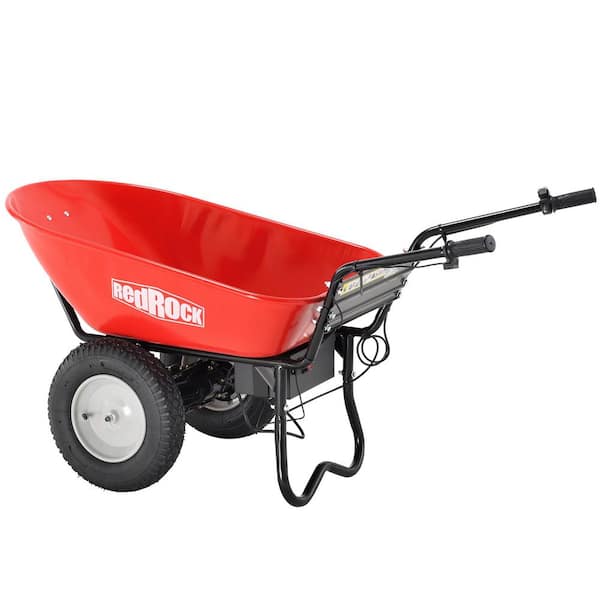
Have you ever wondered how much your wheelbarrow can actually carry? Knowing how many cubic feet your wheelbarrow holds can save you time, effort, and frustration on your projects.
Whether you’re moving soil, mulch, or tools, understanding its capacity helps you plan better and avoid those annoying overloads. Stick with me, and you’ll learn exactly what to expect from your wheelbarrow—and how to make the most of every load.
Credit: www.vevor.ca
Wheelbarrow Sizes
Wheelbarrows come in many sizes to suit different tasks. Knowing how much they hold helps you pick the right one.
The size usually depends on the volume inside the tray. This volume is measured in cubic feet.
Common Capacities
Wheelbarrows have different capacities. Most range from small to large sizes for light to heavy work.
- Small wheelbarrows hold about 2 cubic feet.
- Medium wheelbarrows hold around 4 to 6 cubic feet.
- Large wheelbarrows can hold 8 cubic feet or more.
Measuring Dimensions
To find a wheelbarrow’s cubic feet, measure its length, width, and height.
| Dimension | Average Size (feet) |
| Length | 3 to 4 |
| Width | 1.5 to 2.5 |
| Height | 1 to 1.5 |
Multiply length × width × height to get the volume in cubic feet.
Calculating Volume
Knowing how many cubic feet a wheelbarrow holds helps you plan your work. You can measure the space inside the wheelbarrow to find its volume.
Calculating the volume depends on the shape and size of the wheelbarrow tub. Use simple math to get a close estimate.
Basic Formula
The simplest way to find volume is to multiply length, width, and height. This works if the wheelbarrow tub is box-shaped.
- Measure the inside length of the tub in feet.
- Measure the inside width of the tub in feet.
- Measure the inside height or depth in feet.
- Multiply length × width × height.
- The result is the volume in cubic feet.
Shape Considerations
Most wheelbarrows have curved or sloped sides, not a perfect box. This changes the volume calculation.
| Shape | Volume Formula | Notes |
|---|---|---|
| Rectangular (Box) | Length × Width × Height | Simple to calculate |
| Trapezoidal | [(Top Width + Bottom Width) ÷ 2] × Length × Height | Average the widths |
| Curved or Rounded | Use about 60% to 80% of the box volume | Estimate due to shape |
For curved tubs, multiply the box volume by a factor between 0.6 and 0.8. This gives a better estimate.
Types Of Wheelbarrows
A wheelbarrow is a handy tool for moving heavy loads. They come in different types for various tasks.
Understanding the types of wheelbarrows helps in choosing the right one. Each type has unique features and uses.
Contractor Wheelbarrows
Contractor wheelbarrows are made for heavy-duty tasks. They are strong and durable, perfect for construction sites.
These wheelbarrows often have a high capacity. They can hold more cubic feet of materials compared to other types.
- Made with heavy-duty materials
- High load capacity
- Suitable for construction and landscaping
Residential Wheelbarrows
Residential wheelbarrows are for home use. They are lighter and easier to handle than contractor models.
These are perfect for gardening and small projects. They usually have a lower capacity, suitable for lighter loads.
- Lightweight and easy to maneuver
- Lower load capacity
- Ideal for gardening and small tasks
Specialty Wheelbarrows
Specialty wheelbarrows are designed for specific tasks. They have unique features to meet special needs.
Some have two wheels for better balance. Others may have unique trays for carrying certain materials.
- Designed for specific tasks
- May have two wheels or custom trays
- Best for special projects
Choosing The Right Size
Picking the correct wheelbarrow size helps you work better and faster. It depends on what you plan to carry and how you want to use it.
Understanding your needs will guide you to the right cubic feet capacity. This way, you avoid carrying too much or too little at once.
Project Needs
Think about the type of job you will do. Different projects require different wheelbarrow sizes.
- Small garden tasks usually need a wheelbarrow holding 4 to 6 cubic feet.
- Medium projects like landscaping may need 6 to 8 cubic feet.
- Large construction jobs often require 8 to 10 cubic feet or more.
Material Weight
The weight of materials affects the wheelbarrow size you choose. Heavy materials need smaller loads to avoid strain.
| Material | Weight per Cubic Foot (lbs) | Recommended Wheelbarrow Size (cu ft) |
| Soil | 80 | 4 – 6 |
| Sand | 100 | 4 – 6 |
| Mulch | 20 | 6 – 8 |
| Gravel | 90 | 4 – 6 |
| Concrete Mix | 120 | 3 – 5 |
Maneuverability
A larger wheelbarrow can hold more but may be harder to move. Consider your space and strength before choosing size.
- Choose a size you can comfortably lift and push.
- Look for wheelbarrows with good wheel support.
- Consider narrow designs for tight spaces.
- Test the balance by lifting the handles before buying.
Maximizing Wheelbarrow Capacity
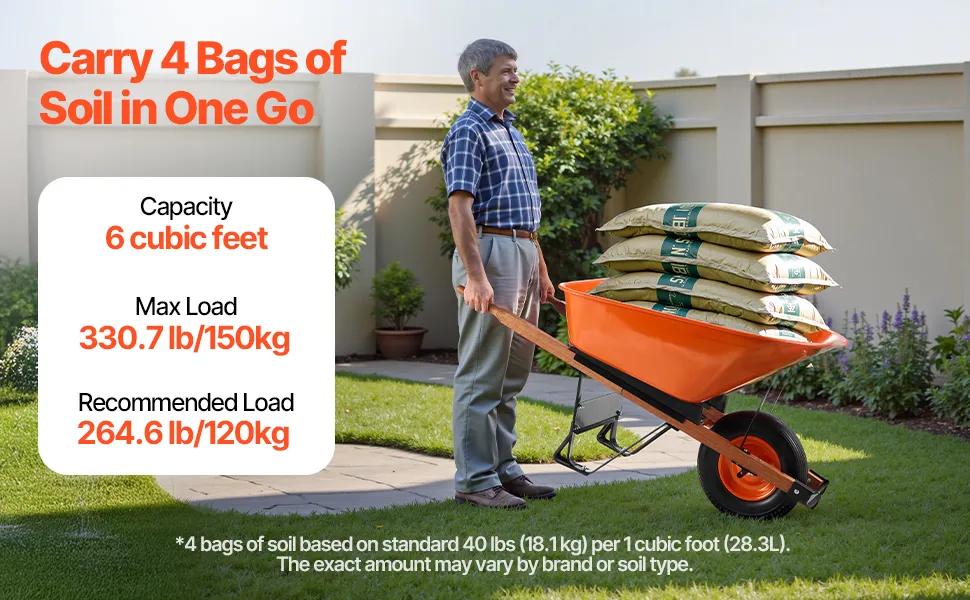
Knowing how much a wheelbarrow can hold helps you work better. Most wheelbarrows hold between 3 to 6 cubic feet. Loading it right keeps you safe and saves time.
Use the space inside the wheelbarrow well. Avoid spills and balance the load. This way, you can carry more in fewer trips.
Proper Loading Techniques
Place heavy items at the bottom to keep the center of gravity low. Spread the load evenly from side to side. Fill the wheelbarrow up to the edges but avoid piling too high.
- Start with heavy, dense materials first
- Fill gaps with smaller items
- Keep the load balanced to one side
- Do not exceed the wheelbarrow’s edge height
Avoiding Overloading
Overloading makes the wheelbarrow hard to control. It can cause spills or tip-overs. Know your wheelbarrow’s weight limit and do not pass it.
| Issue | Effect | Tip |
| Too heavy | Hard to push | Reduce load size |
| Uneven load | Tilt and tip over | Balance materials evenly |
| Over height | Spillage risk | Keep load below rim |

Credit: www.homedepot.com
Converting Volume Units
Understanding the volume a wheelbarrow holds helps in many projects. You can measure this volume in different units. Converting between units makes it easier to compare and plan.
Two common conversions are from cubic feet to cubic yards and liters. These units are useful for different tasks and regions.
Cubic Feet To Cubic Yards
One cubic yard equals 27 cubic feet. To convert cubic feet to cubic yards, divide the cubic feet by 27. This conversion is important for larger volume measurements.
- Measure the volume in cubic feet.
- Divide the number by 27.
- The result is the volume in cubic yards.
For example, if a wheelbarrow holds 9 cubic feet, then it holds 9 ÷ 27 = 0.33 cubic yards.
Cubic Feet To Liters
One cubic foot equals approximately 28.3168 liters. This conversion helps when you need metric units.
| Cubic Feet | Liters |
|---|---|
| 1 | 28.3168 |
| 5 | 141.584 |
| 10 | 283.168 |
| 15 | 424.752 |
To convert cubic feet to liters, multiply the volume in cubic feet by 28.3168. This gives the volume in liters.

Credit: www.vevor.ca
Frequently Asked Questions
How Many Cubic Feet Does A Standard Wheelbarrow Hold?
A standard wheelbarrow typically holds about 6 cubic feet of material. This size is common for garden and construction tasks. However, capacities can vary slightly depending on the brand and model.
Can Wheelbarrow Size Affect Material Volume Capacity?
Yes, wheelbarrow size directly impacts volume capacity. Larger wheelbarrows can hold more cubic feet of material. Smaller models are easier to maneuver but hold less material, usually around 4 cubic feet.
What Materials Can Fit In A 6 Cubic Feet Wheelbarrow?
A 6 cubic feet wheelbarrow can carry soil, gravel, mulch, sand, and concrete mix. This size balances capacity with ease of use for most landscaping and construction jobs.
How To Measure A Wheelbarrow’s Cubic Feet Capacity?
Measure the length, width, and depth of the wheelbarrow’s tray in feet. Multiply these dimensions (L × W × D) to find the volume in cubic feet. This method estimates the carrying capacity accurately.
Conclusion
Knowing how many cubic feet a wheelbarrow holds helps plan your work better. Most wheelbarrows hold between 3 to 6 cubic feet of material. This size suits many gardening and construction tasks. Choosing the right size saves time and effort.
Remember to check the wheelbarrow’s capacity before buying. It makes loading and moving easier. Use this information to pick the best wheelbarrow for your needs. Simple and clear. Work smarter, not harder.