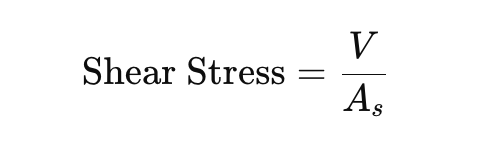
Are you struggling to understand shearing stress and how to calculate it accurately? Knowing how to find shearing stress is crucial if you work with materials, structures, or mechanical parts.
Getting this right can save you from costly mistakes and ensure your designs are safe and strong. You’ll discover simple steps to calculate shearing stress with confidence, even if you’re new to the concept. Keep reading, and by the end, you’ll have a clear, practical method to handle shearing stress in your projects.

Credit: www.youtube.com
Basics Of Shearing Stress
Shearing stress happens when forces push parts of a material in opposite directions. It tries to slide one part over another inside the object.
Understanding shearing stress helps engineers design safe structures and machines. It shows how materials handle force without breaking.
Definition And Importance
Shearing stress is the force per area that acts parallel to a surface inside a material. It causes layers to slide past each other.
It is important because it helps predict if a material will bend, break, or stay strong under force. This makes designs safer and more efficient.
Common Applications
Shearing stress is found in many real-world uses. It appears in things like beams, bolts, and cutting tools.
- Beams in buildings and bridges carry shearing stress from loads.
- Bolt connections face shearing stress from forces holding parts together.
- Scissors and knives use shearing stress to cut materials.
- Metal sheets experience shearing stress during manufacturing processes.

Credit: www.youtube.com
Key Formulas To Know
Shearing stress is the force that causes parts of a material to slide past each other. It is important in engineering and construction. Knowing how to calculate shearing stress helps keep structures safe and strong.
This guide explains the key formulas for shearing stress. It also covers related mechanical properties that affect how materials respond to shear forces.
Shearing Stress Formula
Shearing stress is the force divided by the area where the force acts. It shows how much force is applied over a certain surface.
The basic formula for shearing stress is:
| Symbol | Description | Formula |
|---|---|---|
| τ (tau) | Shearing Stress | τ = F / A |
| F | Force applied parallel to the surface (Newtons) | |
| A | Area over which the force acts (square meters) |
In this formula, τ is in Pascals (Pa) or Newtons per square meter (N/m²). Shearing stress increases if the force goes up or the area goes down.
Related Mechanical Properties
Several mechanical properties relate to shearing stress. These properties help understand how a material behaves under shear forces.
- Shear Modulus (G):Measures how stiff a material is against shear deformation.
- Shear Strain (γ):Shows how much a material deforms due to shearing force.
- Yield Shear Stress:The maximum stress a material can handle before it starts to deform permanently.
Knowing these properties helps engineers choose the right material for specific uses involving shear forces.
Gathering Necessary Data
Calculating shearing stress requires accurate data. Understanding the force and area is vital. This guide will help you gather the necessary information.
Once you have the right data, you can easily find the shearing stress. Let’s learn how to measure force and determine area.
Measuring Force
Force is the push or pull on an object. To measure it, use a force sensor or a spring scale. Make sure the device is calibrated correctly.
Record the force applied to the object. This helps in calculating the stress accurately.
- Use the right tool for measurement
- Ensure the device is zeroed before use
- Record the force in newtons
Determining Area
Area is the surface over which the force acts. Measure it using a ruler or measuring tape. Make sure the measurements are precise.
Calculate the area in square meters. This will help in finding the shearing stress.
- Measure length and width accurately
- Use square meters for calculations
- Check measurements for accuracy

Credit: askfilo.com
Step-by-step Calculation Process
Shearing stress is the force that acts parallel to a surface. It is important in engineering to check if materials can hold up under stress.
This guide shows you how to calculate shearing stress in a few clear steps. Follow along to understand the process.
Preparing The Data
First, gather the needed information. You need the force applied and the area where the force acts.
Make sure the force is in newtons (N) and the area is in square meters (m²). These units are standard for this calculation.
- Measure the force applied (F) in newtons
- Measure the cross-sectional area (A) in square meters
- Confirm units are consistent
Applying The Formula
Use the shearing stress formula: τ = F / A. Here, τ is the shearing stress, F is the force, and A is the area.
Divide the force by the area to find the shearing stress. Write your answer in pascals (Pa) or newtons per square meter.
- Write down the force value
- Write down the area value
- Calculate τ = F ÷ A
- Record the result with correct units
Interpreting The Result
The shearing stress value shows how much force is acting on each square meter. Compare this to the material’s limit.
If the shearing stress is less than the material’s strength, the material is safe. If it is more, the material may fail.
- Check the material’s shearing strength
- Compare your calculated stress to this strength
- Decide if the material can handle the force
Common Mistakes To Avoid
Calculating shearing stress requires careful attention. Simple errors can cause wrong results.
This guide covers common mistakes to avoid when calculating shearing stress.
Incorrect Units
Using wrong units is a common error in shearing stress calculations. Always check units before starting.
Stress is usually measured in pascals (Pa) or pounds per square inch (psi). Mixing units causes wrong answers.
- Do not mix metric and imperial units
- Convert all measurements to the same unit system
- Double-check force and area units before calculating
Misreading Measurements
Incorrectly reading dimensions leads to errors in shearing stress. Measure lengths and areas carefully.
Common mistakes include confusing diameter with radius or reading the wrong side of a ruler.
- Verify if the measurement is radius or diameter
- Use precise tools for length and area measurements
- Double-check numbers before using them in formulas
Tools And Software For Accuracy
Calculating shearing stress accurately is key in engineering and design. Using the right tools helps avoid mistakes and saves time.
Both manual aids and digital tools improve precision. They support better decision-making and safer constructions.
Manual Calculation Aids
Manual aids help check calculations by hand. They are simple and require no electricity or software.
- Graph paper for neat sketches and diagrams
- Scientific calculators for quick arithmetic
- Reference tables with material properties
- Formulas and charts for shear stress calculations
- Slide rules for basic multiplication and division
Digital Tools And Simulations
Digital tools offer fast and precise results. They can simulate real conditions to test designs under stress.
| Tool | Function | Benefit |
| Engineering Software (e.g., ANSYS) | Simulates stress on materials | Shows detailed stress distribution |
| Spreadsheet Programs (e.g., Excel) | Calculates shear stress using formulas | Easy to customize and update data |
| Online Calculators | Instant shear stress results | Quick checks without installation |
| CAD Software | Models parts and analyzes loads | Integrates design and stress analysis |
Practical Examples
Shearing stress happens when forces try to slide one part of a material over another. It is important to calculate this stress to keep structures safe.
We will look at examples for simple beams and complex structures to understand how to find shearing stress.
Simple Beam Shearing Stress
In a simple beam, shearing stress happens where the beam supports weight. The stress is highest near the supports.
To calculate shearing stress in a beam, use the formula:
Where:
- τ = Shearing stress
- V = Shear force at the section
- Q = First moment of area above the point
- I = Moment of inertia of the whole cross-section
- b = Width of the section at the point
For example, if a beam has a shear force of 500 N, a width of 10 cm, and known Q and I values, plug them into the formula to find τ.
Complex Structural Components
Complex structures like I-beams or box girders have varying shapes. Shearing stress changes along different parts.
Calculations need to consider each section’s shape and dimensions carefully to find correct stress values.
| Component | Shear Force (V) | Width (b) | Moment of Inertia (I) | First Moment of Area (Q) | Shearing Stress (τ) |
|---|---|---|---|---|---|
| Flange of I-beam | 800 N | 15 cm | 2000 cm4 | 300 cm3 | τ = (800300) / (200015) = 8 N/cm2 |
| Web of I-beam | 800 N | 5 cm | 2000 cm4 | 500 cm3 | τ = (800500) / (20005) = 40 N/cm2 |
This table shows how shearing stress differs in parts of an I-beam. The web has more stress than the flange.
Frequently Asked Questions
What Is Shearing Stress In Simple Terms?
Shearing stress is the force per unit area acting parallel to a material’s surface. It causes layers to slide against each other, leading to deformation.
How Do You Calculate Shearing Stress Formula?
Shearing stress (τ) is calculated by dividing the shear force (F) by the cross-sectional area (A). The formula is τ = F / A.
Why Is Calculating Shearing Stress Important?
Calculating shearing stress helps predict material failure and ensures structural safety. It is crucial in designing beams, shafts, and mechanical components.
What Units Are Used For Shearing Stress?
Shearing stress is measured in Pascals (Pa) or Newtons per square meter (N/m²) in the SI system, representing force over area.
Conclusion
Calculating shearing stress is simple with the right steps. Understand the force and the area involved clearly. Divide the force by the area to find stress. This helps ensure safety in many engineering projects. Practice these calculations to build confidence and skill.
Keep formulas handy for quick reference anytime. Accurate stress calculation prevents material failure and accidents. Try solving different problems to strengthen your understanding. This knowledge supports strong and durable designs. Stay consistent and patient while learning these basics.