
Have you ever wondered how much power your chest freezer uses? You might be surprised to learn that understanding this can help you save money on your electricity bill.
Every appliance in your home contributes to your monthly expenses, and your chest freezer is no exception. If you’ve been noticing a spike in your bills or are simply curious, it’s time to dig deeper. By knowing how much energy your chest freezer consumes, you can make smarter choices and even reduce your carbon footprint.
Let’s explore the ins and outs of chest freezer energy consumption, and uncover some practical tips to optimize efficiency. Keep reading to discover how a little knowledge can lead to big savings and a more sustainable lifestyle.
Chest Freezer Power Basics
Understanding the basics of chest freezer power use is key to managing your energy bills and choosing the right appliance for your needs. Chest freezers are popular for storing bulk foods, but how much electricity they consume can vary widely. Knowing the fundamentals helps you make smarter decisions about usage and maintenance.
Typical Wattage Range
Most chest freezers use between 100 and 400 watts when running. Smaller models, often under 5 cubic feet, tend to be on the lower end, using around 100 to 150 watts. Larger units, especially those above 15 cubic feet, can draw closer to 300 or 400 watts during operation.
It’s important to remember that these numbers reflect the running wattage, not the starting surge, which can be higher but only lasts a few seconds. Your freezer cycles on and off, so it doesn’t use this power continuously. On average, expect it to run about a third of the time in normal conditions.
Factors Affecting Power Use
Several factors influence how much power your chest freezer consumes beyond just its size. Temperature settings play a big role; colder settings demand more energy. If you keep the freezer too cold, you waste electricity without significant benefits to your food.
Ambient temperature matters too. A freezer in a hot garage or basement will work harder and use more power than one in a cooler, climate-controlled space. How often you open the lid also impacts energy use—every time you open it, warm air enters and the compressor kicks in more frequently.
Insulation quality is another factor. Well-insulated freezers maintain temperature better and reduce power needs. Finally, the age and condition of your freezer affect efficiency. Older models or units with worn seals may use more electricity.

Credit: www.reddit.com
Energy Consumption Metrics
Energy consumption metrics help measure the power a chest freezer uses. They provide clear data on electricity usage. Knowing these numbers helps manage energy bills and choose efficient models. It also supports better planning for household energy needs.
Daily And Annual Usage
Chest freezers use power every day to keep food frozen. The amount of power varies by size and temperature settings. On average, a chest freezer uses about 0.5 to 1.5 kilowatt-hours (kWh) daily.
Annual energy use depends on daily consumption. Multiply daily kWh by 365 for yearly figures. For example:
- 0.8 kWh daily × 365 days = 292 kWh per year
This number helps estimate yearly electricity costs. Lower kWh means less energy and lower bills.
Understanding Kilowatt-hours
Kilowatt-hour (kWh) measures electrical energy consumption. It equals using 1,000 watts for one hour. Freezers show power use in watts on labels or manuals.
To find daily kWh, multiply power rating by hours used, then divide by 1,000. For example, a 150-watt freezer running 8 hours:
- 150 watts × 8 hours = 1,200 watt-hours = 1.2 kWh
This simple calculation reveals real power use. Understanding kWh helps compare appliances and improve energy efficiency.
Calculating Energy Costs
Understanding how much power your chest freezer uses is just the first step. The real question is, how does that translate into your monthly energy bill? Calculating energy costs can help you make smarter decisions about usage and budgeting.
Using Local Electricity Rates
Your chest freezer’s power consumption is usually measured in watts or kilowatt-hours (kWh). To figure out what that means in terms of cost, you need to know your local electricity rate.
Electricity rates can vary widely, often ranging between $0.10 and $0.30 per kWh depending on where you live. Check your most recent electric bill or your utility provider’s website for the exact rate.
For example, if your freezer uses 200 kWh per month and your electricity rate is $0.12 per kWh, you multiply 200 by 0.12 to get $24. That’s your estimated monthly electricity cost for running the freezer.
Estimating Monthly Expenses
Once you have your local rate, you can estimate the monthly expenses by considering how long your freezer runs daily.
- Find the freezer’s power rating in watts (usually on a label inside or in the manual).
- Estimate average daily running time (for example, 8 hours).
- Calculate daily energy use: (Watts × Hours) ÷ 1000 = kWh per day.
- Multiply daily kWh by 30 for a monthly estimate.
- Multiply that by your local electricity rate for the cost.
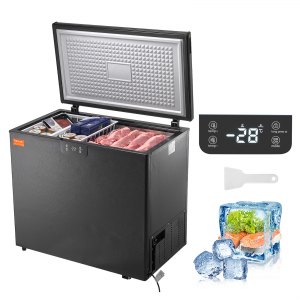
Let’s say your freezer is rated at 150 watts and runs about 8 hours a day. The daily energy use is (150 × 8) ÷ 1000 = 1.2 kWh. Over a month, that’s 36 kWh. At $0.15 per kWh, your monthly cost is 36 × 0.15 = $5.40.
Have you ever considered how adjusting your freezer’s temperature or usage schedule could reduce these costs? Small changes might make a noticeable difference in your electric bill.
Credit: www.vevor.com
Energy Efficiency Tips
Reducing the power consumption of your chest freezer doesn’t have to be complicated. Small adjustments can make a big difference in energy use and your electricity bill. Let’s look at some practical tips that keep your freezer running efficiently without sacrificing performance.
Optimal Temperature Settings
Setting the right temperature is key to saving energy. Your chest freezer should ideally be set at around 0°F (-18°C). This temperature keeps your food safe without overworking the compressor.
Have you ever noticed your freezer running constantly? It might be too cold. Lowering the temperature by just a few degrees can increase energy use significantly. Avoid setting it colder than necessary.
Try using a freezer thermometer to monitor the temperature. This simple tool helps you maintain the ideal setting and avoid guesswork.
Maintenance For Lower Consumption
Keeping your chest freezer clean and well-maintained directly impacts its energy use. Dust and dirt on coils make the compressor work harder. Cleaning these coils every six months can reduce energy consumption.
Check the door seal regularly. If the gasket is worn or damaged, cold air escapes, forcing your freezer to use more power. Replacing a faulty seal is a quick fix that saves energy.
Also, defrost your freezer as soon as you see ice build-up. Thick frost layers reduce cooling efficiency and increase power use. It’s a small task that pays off in lower energy bills.
Comparing Chest Freezers To Other Appliances
Understanding the power use of chest freezers helps in choosing the right appliance. Comparing chest freezers to other common appliances shows their energy efficiency clearly. This comparison aids in managing electricity bills and environmental impact.
Versus Upright Freezers
Chest freezers usually use less electricity than upright freezers. Their design keeps cold air inside better when opened. Upright freezers lose more cold air due to vertical doors. Chest freezers have thicker insulation which reduces power needs. They run longer cycles but use less energy overall. Upright freezers offer easier access but at a cost of higher energy use.
Energy Use Compared To Refrigerators
Chest freezers often consume less power than refrigerators. Refrigerators run constantly to keep fresh food cool. Chest freezers work mainly to maintain frozen items at low temperatures. They have fewer temperature fluctuations, lowering energy use. Refrigerators use more electricity due to defrost cycles and frequent door openings. Chest freezers are ideal for long-term storage with lower power costs.

Credit: naturesgenerator.com
Choosing An Energy-saving Model
Choosing an energy-saving chest freezer can make a big difference in your electricity bill and environmental impact. It’s not just about picking any model; you need to look for specific features that help reduce power consumption. Understanding these details helps you make a smart choice that fits your needs and budget.
Energy Star Ratings
Look for chest freezers with Energy Star ratings. These models meet strict energy efficiency guidelines set by the government. They use less electricity compared to standard freezers, saving you money over time.
Energy Star freezers often have better insulation and more efficient compressors. This means they keep your food frozen using less power. Have you checked if your current freezer has this rating? If not, upgrading could lower your energy use significantly.
Size And Capacity Considerations
Choosing the right size is crucial for saving energy. A larger freezer uses more power, but buying one that’s too small means you might overfill it, which can reduce efficiency.
Think about how much frozen storage you really need. If you only store a few items, a smaller model will use less electricity. On the other hand, if you regularly freeze large batches of food, a bigger freezer might be worth the extra energy cost.
Have you ever noticed that an overstuffed freezer seems to run more often? Keeping some space inside helps air circulate and maintains a consistent temperature, which can reduce power use. Balancing size and capacity with your actual needs is key to energy savings.
Frequently Asked Questions
How Much Electricity Does A Chest Freezer Consume?
A chest freezer typically uses between 100 to 400 watts per hour. Energy consumption depends on size, model, and usage frequency. On average, it consumes about 200 kWh annually. Efficient models use less power, saving electricity and reducing bills.
What Factors Affect Chest Freezer Power Usage?
Power usage depends on freezer size, insulation quality, and compressor efficiency. Frequent opening increases energy consumption. Ambient temperature also impacts power needs. Proper maintenance and placement in cool areas reduce electricity use.
How To Calculate A Chest Freezer’s Power Cost?
Multiply the freezer’s wattage by hours used daily, then convert to kilowatt-hours. Multiply this by your electricity rate to estimate monthly costs. This helps understand energy expenses and manage electricity bills effectively.
Are Chest Freezers More Energy-efficient Than Upright Freezers?
Yes, chest freezers generally use less energy. Their design minimizes cold air loss when opened. They maintain temperature efficiently, reducing compressor runtime and power consumption compared to upright models.
Conclusion
A chest freezer uses a moderate amount of power. Its energy use depends on size and settings. Choosing an efficient model helps save electricity. Keeping it full and well-sealed also reduces power waste. Regular maintenance ensures it runs smoothly and uses less energy.
Knowing how much power it uses helps plan your electricity budget. Small changes make a big difference over time. A chest freezer can be energy-friendly with simple care.