Have you ever wondered what a deep vacuum is and how it’s measured? You might be surprised to learn that understanding this concept could be the key to enhancing your technical skills, especially if you work in fields like refrigeration, HVAC, or laboratory science.
By diving into the specifics of vacuum measurement, you can uncover insights that could streamline your work and boost your efficiency. Imagine having the clarity to troubleshoot issues faster and with more precision. As you read on, you’ll discover how mastering the nuances of vacuum measurement can transform your approach and elevate your expertise to a whole new level.
So, are you ready to unlock the secrets behind deep vacuum measurement?

Credit: www.reddit.com
Basics Of Deep Vacuum
Understanding the basics of deep vacuum is essential if you work with technologies that require extremely low pressure environments. Deep vacuum refers to a condition where the pressure inside a chamber is much lower than the atmospheric pressure. This state allows certain physical and chemical processes to occur more efficiently, which is why precise measurement is crucial.
Defining Deep Vacuum
Deep vacuum is typically defined as a pressure range below 10-3torr, or about 0.001 millimeters of mercury (mmHg). At this level, the number of gas molecules in the space is drastically reduced, creating an environment that resembles outer space more than everyday air. You might wonder, why measure such low pressures? Because even tiny amounts of residual gas can affect sensitive equipment or experiments.
Pressure in deep vacuum is usually measured using specialized instruments like ionization gauges or cold cathode gauges. These devices can detect extremely low pressures that standard vacuum gauges cannot measure accurately. If you’ve ever worked with vacuum systems, you know that choosing the right gauge is key to reliable results.
Applications Requiring Deep Vacuum
Many industries rely on deep vacuum to achieve high-quality outcomes. Semiconductor manufacturing is a prime example where deep vacuum allows for controlled environments during chip fabrication. Without it, contamination and defects can occur easily.
Other fields include:
- Space simulation chambers, where spacecraft are tested under near-space conditions
- Electron microscopy, which requires a deep vacuum to prevent electron scattering
- Thin film deposition, used in creating coatings for optics and electronics
Have you considered how the absence of air impacts your own work or experiments? Understanding where deep vacuum fits into your process can improve both precision and efficiency.
Common Units For Vacuum Measurement
Understanding the common units used for measuring deep vacuum helps you grasp how precise and sensitive vacuum technology can be. These units reflect different scales and standards, making it easier to compare vacuum levels across various equipment and industries. Knowing these units also empowers you to read vacuum gauges accurately and communicate your vacuum needs effectively.
Pascal And Millibar
The Pascal (Pa)is the SI unit for pressure and is widely used in scientific and engineering fields. One Pascal equals one newton per square meter, which makes it very useful for precise measurements.
The Millibar (mbar)is another common unit, especially in meteorology and vacuum technology. One millibar equals 100 Pascals, so it’s easy to convert between these two units.
If you’re working on vacuum systems for HVAC or weather monitoring, you’ll often see pressure values expressed in Pascals or millibars.
Torr And Millimeter Of Mercury
The Torrand Millimeter of Mercury (mmHg)are closely related and often used interchangeably. Both measure pressure based on the height of a mercury column.
One Torr equals exactly 1 mmHg, making it straightforward to understand. These units are popular in fields like vacuum physics and medical applications such as blood pressure measurement.
Have you ever noticed your doctor mentioning mmHg during a checkup? This shows how these units connect everyday experiences with technical measurements.
Inches Of Mercury
Inches of Mercury (inHg)is a unit mostly used in the United States for vacuum measurement. It measures pressure based on the height of a mercury column in inches.
This unit is common in automotive and HVAC industries, especially for measuring vacuum in engines or air conditioning systems. Knowing how many inches of mercury your equipment needs can help you maintain optimal performance.
Would you guess that your car’s vacuum gauge might be measuring in inHg? It’s a practical unit that many technicians rely on daily.
Specialized Units For Deep Vacuum
Measuring deep vacuum requires precision and clarity because the pressures involved are extremely low. Standard units used in everyday pressure measurements don’t cut it here. Instead, specialized units help you understand and quantify these tiny pressures accurately, ensuring your equipment and processes perform as expected.
Microns And Microns Of Mercury
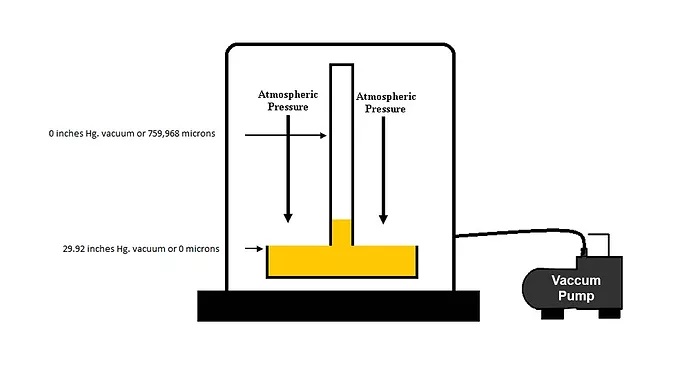
Microns, often called microns of mercury, are a common unit for deep vacuum measurement. One micron equals one-thousandth of a millimeter of mercury (mmHg). This scale is easy to visualize if you’ve ever seen a mercury barometer or vacuum gauge.
In practical terms, a vacuum level of 10 microns means the pressure is just 0.01 mmHg. This is much lower than atmospheric pressure, which is about 760 mmHg. Using microns allows technicians to track and maintain extremely low pressures efficiently.
Nanopascals
The pascal (Pa) is the SI unit for pressure, but in deep vacuum applications, nanopascals (nPa) come into play. One nanopascal equals one-billionth of a pascal, illustrating how sensitive these measurements are. It’s a unit favored in scientific research where exact vacuum levels are critical.
Using nanopascals can give you a clearer picture of how close you are to achieving a near-perfect vacuum. It’s a challenge to measure these pressures without specialized equipment, but understanding this unit bridges the gap between theory and practice.
Atmospheres And Their Fractions
Vacuum is sometimes expressed as a fraction of an atmosphere (atm). Since one atmosphere equals the pressure at sea level (about 101,325 Pa), fractions like 10^-6 atm indicate a very deep vacuum. This method is especially useful in industries where atmospheric pressure serves as a baseline.
When you hear about a vacuum level of 10^-5 atm, it means the pressure is just a tiny fraction of what you feel around you every day. Thinking in terms of atmospheres helps connect abstract numbers to real-world pressure differences you can relate to.
Credit: www.terrauniversal.com
Instruments Measuring Deep Vacuum
Measuring deep vacuum requires precise and sensitive instruments. These devices detect extremely low pressure levels in vacuum systems. They help maintain the required environment for scientific and industrial processes.
Different instruments work best at varying vacuum ranges. Each type uses unique technology to measure pressure accurately. Understanding these tools helps in choosing the right one for specific tasks.
Ionization Gauges
Ionization gauges measure pressure by ionizing gas molecules. The ions created are collected to produce a current. This current relates directly to the vacuum level. They work well in ultra-high vacuum conditions, as low as 10-10torr. These gauges need a stable power source and clean conditions to operate properly.
Penning Gauges
Penning gauges use a magnetic field to trap electrons. The trapped electrons collide with gas molecules, causing ionization. The ion current measured indicates the vacuum pressure. These gauges are robust and work in a range from 10-3to 10-8torr. They are commonly used in laboratory and industrial vacuum systems.
Cold Cathode Gauges
Cold cathode gauges do not use filaments for electron emission. Instead, they rely on high voltage to create a glow discharge. This discharge ionizes gas molecules, producing ions to measure pressure. These gauges are durable and suitable for rough vacuum to ultra-high vacuum ranges. They require less maintenance and have a long service life.
Converting Between Vacuum Units
Converting between vacuum units can seem tricky at first, especially because deep vacuum measurements often use several different units depending on the application and industry. Understanding how to switch between these units accurately is key to interpreting data correctly and ensuring your equipment runs smoothly. Let’s break down the most common conversion factors and some tips to keep your calculations precise.
Common Conversion Factors
Vacuum pressure is commonly measured in units like torr, pascal (Pa), millibar (mbar), and inches of mercury (inHg). Knowing the exact relationships between these units helps you avoid costly mistakes.
| Unit | Equivalent Value | Notes |
|---|---|---|
| 1 Torr | 133.322 Pa | Also equal to 1 mmHg |
| 1 Pascal (Pa) | 0.0075 Torr | SI unit of pressure |
| 1 mbar | 100 Pa | Common in meteorology |
| 1 inHg | 3386.39 Pa | Used mainly in the US |
For example, if your vacuum gauge reads 500 mbar but your equipment specification requires pascals, multiply 500 by 100 to get 50,000 Pa. Simple conversions like this keep your data consistent and your systems safe.
Tips For Accurate Conversion
Always double-check which unit your device uses before converting. Mixing up units like torr and mbar can lead to serious errors in vacuum levels.
- Use reliable sourcesor conversion calculators to avoid manual errors.
- Keep track of decimal placesto maintain precision, especially in deep vacuum ranges where small differences matter.
- Be aware of unit context:some industries prefer specific units, so stick to those when reporting or recording data.
I once misread a vacuum level in inches of mercury as torr, which caused a delay in a project. It taught me that conversion errors aren’t just theoretical—they can impact real-world results. How do you ensure your vacuum measurements are accurate? Double-check your conversions and stay consistent to avoid surprises.
Choosing The Right Unit
Choosing the right unit to measure deep vacuum is crucial for getting accurate and meaningful results. Different industries and applications require various measurement scales and tools. Picking the correct unit helps you avoid confusion and ensures your data aligns with industry practices.
Industry Standards
Each industry tends to prefer specific units for measuring deep vacuum. For example, the semiconductor industry often uses Torr or microns due to their suitability for ultra-high vacuum environments.
In contrast, scientific research might rely on Pascals or millibar for consistency with the International System of Units (SI). If you don’t match the industry standard, you risk miscommunication and errors in interpretation.
Before deciding, check what units your suppliers, clients, or regulatory bodies expect. This keeps your work aligned and trustworthy.
Measurement Precision Needs
Your choice also depends on how precise your vacuum measurement needs to be. For rough estimates, units like inches of mercury (inHg) might suffice.
But for detailed experiments or manufacturing processes, you’ll want units that can measure very low pressures with high accuracy, such as microns or nanometers of mercury.
Ask yourself: How sensitive does your equipment need to be? Can your sensors detect changes in the vacuum level at the scale you require? Matching precision needs with the right unit prevents wasted effort and inaccurate readings.

Credit: www.achrnews.com
Frequently Asked Questions
What Units Measure Deep Vacuum Pressure?
Deep vacuum is usually measured in units like torr, pascals (Pa), or microns. Torr and microns are common in vacuum technology. Pascals are used in scientific contexts. These units help quantify extremely low pressures below atmospheric levels.
How Is Deep Vacuum Pressure Different From Low Vacuum?
Deep vacuum refers to pressures below 0. 001 torr, much lower than low vacuum. It requires specialized equipment for measurement. Low vacuum ranges from atmospheric pressure down to about 1 torr. Deep vacuum measurements demand higher precision and sensitivity.
Why Use Torr Or Microns For Deep Vacuum?
Torr and microns are convenient for very low pressures. One torr equals 1/760 of atmospheric pressure. Microns represent one-thousandth of a torr. These units allow accurate readings in deep vacuum systems where standard pressure units are too large.
Can Pascals Measure Deep Vacuum Accurately?
Yes, pascals can measure deep vacuum but often require sensitive gauges. 1 pascal equals one newton per square meter. In deep vacuum, pressures can be as low as 0. 1 pascal or less. Scientific industries may prefer pascals for standardized reporting.
Conclusion
Deep vacuum measures how empty a space is from air and gases. It uses units like torr, pascal, or microns to show this. Knowing these units helps understand vacuum strength clearly. Different fields need specific vacuum levels for their work.
This knowledge makes it easier to choose the right tools. Remember, deep vacuum means very low pressure inside a container. Understanding these basics helps in science and industry tasks. Keep these points in mind for better vacuum use and results.