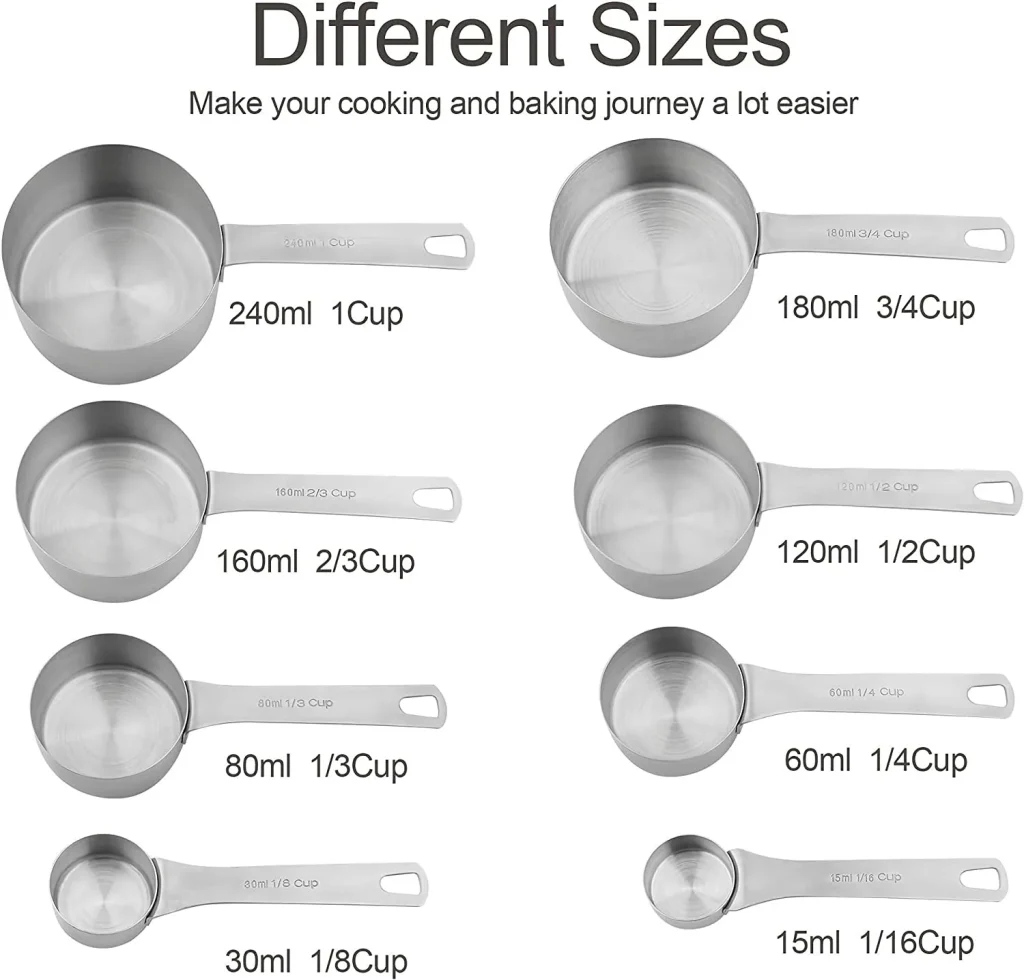
Are you struggling to measure 1/8 cup accurately in your recipes? You’re not alone.
Getting the right amount can be tricky, especially when your measuring tools don’t have that exact mark. But don’t worry—this simple guide will show you easy ways to measure 1/8 cup every time. Whether you’re baking a cake or cooking a savory dish, mastering this small measurement can make a big difference in your results.
Keep reading to discover tips and tricks that will save you time and frustration in the kitchen.

Credit: www.amazon.com.au
Tools For Measuring 1/8 Cup
Measuring 1/8 cup can be tricky without the right tools. Accurate measurements help you cook and bake with confidence.
This guide shows common tools that make measuring 1/8 cup easy and reliable.
Measuring Spoons Vs. Cups
Measuring spoons are small tools designed for precise amounts like 1/8 cup. Standard measuring cups usually start at 1/4 cup, which is twice as much.
- Measuring spoons often include a 1/8 cup size or equivalent (2 tablespoons).
- Measuring cups are best for larger amounts but can be less precise for small volumes.
- Spoons fit well for dry and liquid ingredients in small quantities.
Using A Kitchen Scale
A kitchen scale can measure 1/8 cup by weight. This method works well for dry ingredients.
| Ingredient | Weight for 1/8 Cup |
| Flour | 15 grams |
| Sugar | 25 grams |
| Butter | 28 grams |
Use the scale’s tare function to zero the container before adding ingredients.
Alternative Household Items
If you lack measuring tools, some household items help approximate 1/8 cup.
- A standard tablespoon is about 1/16 cup, so two tablespoons equal 1/8 cup.
- Use a small medicine cup, often marked in milliliters; 1/8 cup equals 30 ml.
- Shot glasses usually hold about 1 ounce or 1/8 cup.

Credit: kaffeproducts.com
Step-by-step Measuring Guide
Measuring 1/8 cup accurately helps your recipes turn out right. This guide shows you how to measure this small amount with ease.
Follow the steps below to get the perfect 1/8 cup measurement every time.
Leveling Your Ingredient
Fill your 1/8 cup measuring tool with the ingredient. Do not pack it down unless the recipe says so.
Use a flat edge, like the back of a knife, to level off the top. This removes extra ingredient and gives you an exact measure.
- Fill the measuring cup slightly above the rim.
- Hold a flat edge tool across the top.
- Swipe gently to remove excess.
Avoiding Common Mistakes
Do not scoop ingredients directly with the cup. This can pack the ingredient and give too much.
Check that your measuring cup is clean and dry before use. Wet cups can cause ingredients to stick and change amounts.
- Use a spoon to add dry ingredients into the cup.
- Level each ingredient for accuracy.
- Do not guess amounts; use the right tool.
Measuring Liquids Vs. Solids
Use liquid measuring cups for liquids like water or oil. These cups have space to avoid spills.
Dry measuring cups work best for solid ingredients like flour or sugar. Fill and level these cups for accuracy.
- Liquids: Use clear cups with a spout.
- Solids: Use cups you can level off.
- Measure liquids on a flat surface at eye level.
Tips For Accurate Baking
Measuring small amounts like 1/8 cup can affect your baking results. Accuracy helps your recipes turn out just right.
Use simple techniques to measure ingredients well. This guide shares easy tips for better baking measurements.
Consistent Ingredient Preparation
Always prepare ingredients the same way before measuring. For example, flour should be sifted or spooned into the cup.
- Sift dry ingredients for light texture
- Use level spoons to fill the cup
- Pack brown sugar firmly if the recipe says so
- Chop or crush nuts evenly before measuring
Adjusting For Ingredient Density
Different ingredients have different weights even in the same volume. Know the density to measure correctly.
| Ingredient | 1/8 Cup Weight (Approx.) |
|---|---|
| All-purpose flour | 15 grams |
| Sugar | 25 grams |
| Butter | 28 grams |
| Chopped nuts | 20 grams |
When To Use Weight Over Volume
Weighing ingredients is more accurate than using cups. This is important for baking success.
- Use a digital kitchen scale for small amounts
- Convert recipes to grams for best results
- Zero the scale before adding each ingredient
- Store your scale nearby for easy use
Quick Hacks When Measuring Tools Are Missing
Sometimes you need to measure 1/8 cup but do not have the right tools. You can use simple tricks to get close to the right amount.
These hacks help you cook or bake without stopping to find measuring cups. Use things around you to estimate well.
Estimating 1/8 Cup Using Tablespoons
Tablespoons are common in most kitchens. You can use them to measure 1/8 cup easily.
Since 1 cup equals 16 tablespoons, 1/8 cup is 2 tablespoons.
- Fill a tablespoon twice to get 1/8 cup
- Use a clean spoon for dry or liquid ingredients
- Level off the spoon for accuracy
Using Visual References
You can guess 1/8 cup by comparing it to common objects. This helps when no tools are nearby.
For example, 1/8 cup is about the size of a large egg or half a golf ball.
- 1/8 cup roughly equals 2 fluid ounces
- It fits in a small juice glass or shot glass
- Use these items as quick measuring guides
Diy Measuring Tools
You can make simple measuring tools at home if none are available. Use plastic or paper cups and mark them.
Mark the 1/8 cup level using a ruler and a marker. This makes a reusable tool.
| Container | Mark for 1/8 Cup |
|---|---|
| Plastic cup (1 cup size) | Fill to 2 tablespoons or 30 ml |
| Glass jar | Measure 30 ml and mark the line |
| Small bowl | Use a spoon to fill and mark the height |
Common Ingredient Conversions
Measuring 1/8 cup can be tricky without the right tools. Knowing common ingredient conversions helps in cooking and baking.
This guide shows you how to measure 1/8 cup for different ingredients like flour, sugar, butter, oils, and liquids.
Flour And Sugar
Flour and sugar have different weights for the same volume. This matters for accurate baking results.
| Ingredient | 1/8 Cup Equivalent |
| All-Purpose Flour | 1 ounce (28 grams) |
| Granulated Sugar | 1.75 ounces (50 grams) |
| Powdered Sugar | 0.5 ounces (14 grams) |
Butter And Oils
Butter and oils have different densities but share the same volume measurement for 1/8 cup.
- Butter: 2 tablespoons or 1 ounce (28 grams)
- Vegetable Oil: 2 tablespoons or 1 fluid ounce (30 ml)
- Olive Oil: 2 tablespoons or 1 fluid ounce (30 ml)
Liquids Like Milk And Water
Milk and water have nearly the same weight and volume conversion for 1/8 cup.
| Liquid | 1/8 Cup Volume | Weight |
|---|---|---|
| Water | 2 tablespoons (30 ml) | 1 ounce (30 grams) |
| Milk | 2 tablespoons (30 ml) | 1.03 ounces (29 grams) |
Credit: www.dioro.com
Frequently Asked Questions
What Tools Can Measure 1/8 Cup Accurately?
To measure 1/8 cup accurately, use a set of measuring spoons. Typically, 1/8 cup is equivalent to 2 tablespoons. Having a kitchen scale is also beneficial. This will ensure precise measurements, especially for baking.
Can I Use Tablespoons To Measure 1/8 Cup?
Yes, you can use tablespoons to measure 1/8 cup. Simply use two tablespoons to achieve the equivalent of 1/8 cup. This method is convenient and ensures accuracy, especially when precise measurements are essential in recipes.
Why Is Measuring 1/8 Cup Important In Recipes?
Measuring 1/8 cup is crucial for recipe accuracy. Precise measurements ensure the right texture and taste in dishes. It prevents ingredient wastage and helps maintain consistency. This is particularly important in baking, where exact proportions can make or break a recipe.
Is 1/8 Cup Measurement Common In Cooking?
Yes, 1/8 cup measurement is common, especially in baking. It helps in precise ingredient portions. While not as frequently mentioned as larger measurements, it is essential for accuracy. Many recipes, especially those for smaller servings, require it for perfect results.
Conclusion
Measuring 1/8 cup is simple with the right tools. Use a measuring spoon or cup for accuracy. Remember, precision helps your recipe turn out well. Even small amounts affect taste and texture. Practice makes it easier to measure quickly. Keep your kitchen tools clean and ready.
This small step improves your cooking every time. Enjoy baking and cooking with confidence.